news

Viewing posts from the news category

Increasing MS lipidomics power through parameter optimization and In Silico Simulation

Hutchins et al (2019) recently published a paper in Analytical Chemistry presenting an algorithm which identifies parameter sets in a way that is quicker and more accurate than typical methods.

The issue of effectively profiling the diversity and range of biomolecules is an important one to consider in Mass Spectrometry, and relies on well-sought out selection of acquisition parameters. However, acquisition parameters are generally selected in a way that is time-consuming and tends to produce lacking results.

By creating an algorithm which simulates LC-MS/MS lipidomic data acquisition performance in a benchtop quadrupole-Orbitrap Mass Spectrometer system and pairing it with an algorithm that defines constrained parameter optimization, researchers were able to efficiently identify LC-MS/MS method parameter sets for specific sample matrices. Additionally, researchers used a simulation called in silico to demonstrate how developments in mass spectrometer speed and sensitivity will result in even more effective biomolecule identification.
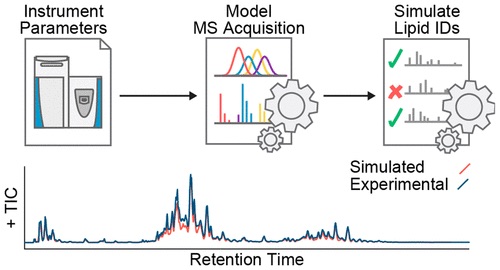
Graphical abstract from Hutchins et al (2019) which details the parameter optimization and in silico simulation methods.
Instrument parameters --> model MS acquisition --> simulate lipid IDs.

Identification of Alzheimer’s Biomarkers for Early Diagnosis and Treatment

Alzheimer’s disease begins with a long, hard-to-discern and symptom-free phase which may be a key opportunity for early diagnosis and therapeutic intervention. Zhong et al (2019) defined reliable and valid biomarkers that could identify the disease during this period, as published in a recent article in Frontiers in Molecular Neuroscience. 

Alzhiemer’s disease is a progressive neurodegenerative disease which is characterized by the progressive buildup of senile plaques, neurofibrillary tangles, and loss of synapses and neurons in the brain. Behaviorally, this is presented as a progressive degeneration of overall function, such as difficulty with memory, mood instability and loss of motor function. Currently, there is no cure.

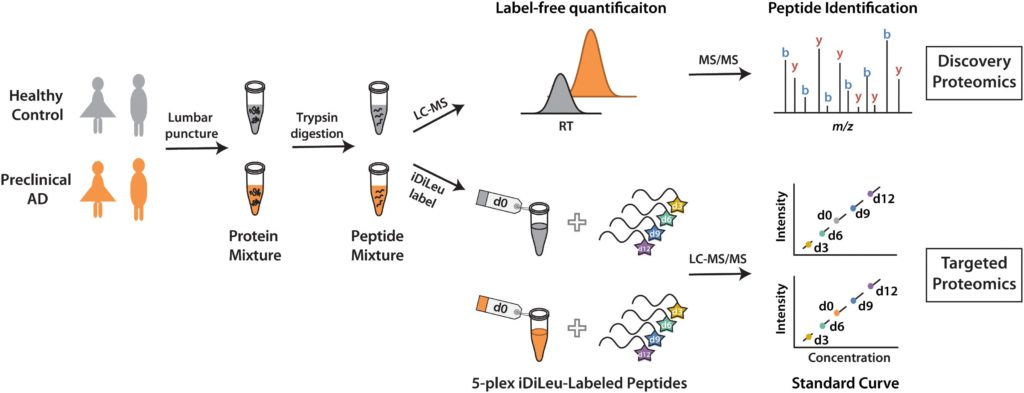
Using discover proteomics analysis of cerebrospinal fluid (CSF), Zhong et al found that in both healthy controls and in preclinical Alzheimer’s Disease patients, 732 proteins in women and 704 men proteins in men had more than one unique peptide. Then, Zhong et al found that 79 (women) and 98 (men) proteins were significantly altered in preclinical alzheimer’s patients who have already demonstrated some symptoms of mild cognitive impairment or dementia.

Using N,N-dimethyl leucine (iDiLeu) tags, researchers verified the Alzheimer’s disease biomarkers called neurosecretory protein VGF and apolipoprotein E. Then, researchers used a four-point internal calibration curve to determine the “absolute amount” of target analytes in cerebrospinal fluid through a single liquid chromatography-mass spectrometry run.

Graphical abstract for Zhong et al (2019) depicting the difference between healthy control and preclinical Alzheimer's Disease biomarkers in label free and labeled quantification and peptide identification.

An Accurate Mass Defect-based labeling strategy for Quantitative Proteomics

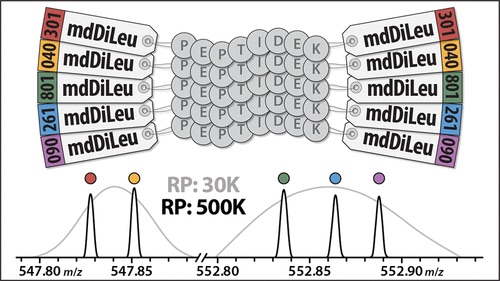
Zhong et al (2019) wrote about their development of an accurate mass-defect based labelling strategy for MS1-centric quantification in a recent Analytical Chemistry paper. 

Specifically, researchers developed 5-plex mass defect N, N-dimethyl leucine (mdDiLeu) tags. These tags have multiple benefits; they can aid in the quantification of biological samples and have increased multiplexing due to the addition of mass difference isotopologues. Additionally, the synthesis of these cost effective tags is straightforward and only requires one reaction step, which can be done in any lab. Also, this mass defect-based labelling strategy is more accurate than isobaric label-based reporter ion quantification, as the latter is impacted by ratio compression.

In this paper, Zhong et al (2019) demonstrate the efficacy of 5-plex mdDiLeu tags for quantitative proteomics by conducting mass spectrometry experiments with these tags on labelled Saccharomyces cerevisiae lysate digest.

Graphical abstract for Zhong et al (2019) depicting the accurate mass-defect labelling strategy used.

Quantification of the Human Pancreatic ECM

Ma et al (2019) recently published a paper on the quantification of human pancreatic extracellular matrix proteins in the Journal of Proteome Research.

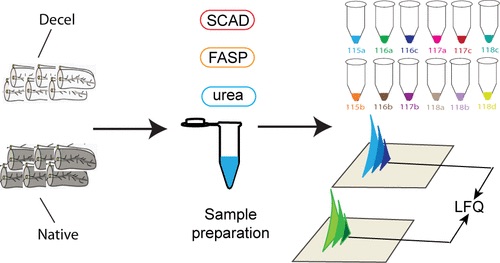
In this study, researchers characterized the composition of the human pancreatic extracellular matrix (ECM) before and after decellularization. To find the relative quantification of ECM proteins, they used isobaric dimethylated leucine (DiLeu) labeling.

It was important for researchers to look at the ECM of the pancreatic microenvironment as it is essential to pancreatic function– it regulates β cell proliferation, differentiation, and insulin secretion.

As a result of decellularization, and through quantitative proteomic analysis, most cellular proteins were removed while matrisome proteins remained. This process generated a large data set of matrisome proteins from a single tissue type. 

Researchers then quantified the distinct expression of ECM proteins, comparing adult and fetal pancreas ECM. This revealed a correlation between matrix composition and postnatal β cell maturation.

Overall, the results of this study sheds light on the prospect of bioengineering a pancreas. Additionally, the study demonstrates the roles that matrisome proteins have in postnatal β cell maturation.

Graphical abstract for Ma et al (2019), depicting native and decelled pancreatic extracellular matrix proteins, sample preparation technique, and LFQ

Fixed mass-to-charge ratio scan ranges generates more MS/MS scans than standard approaches

Trujillo et al (2019) published an article on maximizing tandem mass spectrometry acquisition rates for shotgun proteomics in a recent issue of Analytical Chemistry.

While advances in mass spectrometry (MS/MS) have lead to increased performance in shotgun proteomics experiments, ion trap scan duration is highly variable and often depends on the mass of the precursor.

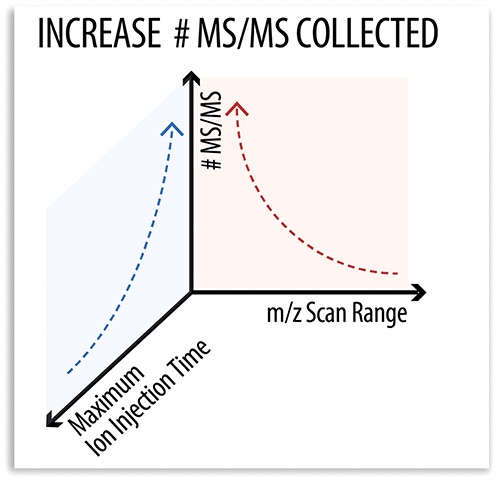
Looking into this variability, the authors compared the performance of various static mass-to-charge ratio scan ranges for ion trap MS/MS acquisition to conventional dynamic mass-to-charge ratio scan ranges. Compared to the standard dynamic approach, the fixed mass-to-charge ratio scan range generated 12% more MS/MS scans and identified more unique peptides.

Graphical abstract for Trujillo et al (2019) depicting a graph titled "Increase # MS/MS collected." We see that as the maximum ion injection time decreases, the number of MS/MS collected increases. Additionally, as the m/z scan range increases, the # of MS/MS increases as well.

Acute-Phase proteins differ in mice with and without prostate inflammation

L. Hao et al conducted a quantitative proteomic analysis on induced prostate inflammation in mice and published a paper in the American Journal of Physiology-Renal Physiology.

Researchers compared the quantitative proteomic analysis of urine from mice with and without prostate-specific inflammation. Prostate inflammation as it is a key symptom of many different prostate conditions, such as infection and cancer, and therefore by doing so one gains a better understanding of disease mechanisms.

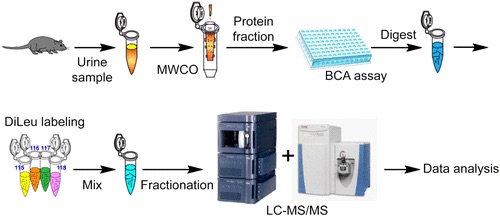
Researchers induced prostate-specific inflammation by conditional prostate epithelial IL-1β expression. Next, they ran urine sample tests and quantified urinary proteins. L. Hao et al found that different levels of acute-phase response proteins (proteins which have plasma concentrations that increase or decrease in response to inflammation) were represented between mice with and without prostate inflammation; these were haptoglobin, inter-α-trypsin inhibitor, and α1-antitrypsin 1-1.

Mass-spectrometry-based quantitative urinary proteomics is an important and powerful method for discovering biomarkers and uncovering molecular urological mechanisms.

Graphical abstract for Hao et al, depicting the quantitative proteomic analysis of mice urine.

Polo-like kinase 4 maintains integrity of centriolar satellites

RA Denu et al recently published a paper on the importance of polo-like kinase 4 for centriolar satellite integrity in the Journal of Biological Chemistry.

Polo-like kinase 4 (PLK4), a Ser/Hr protein kinase, is the “master regulator” of centriole duplication and can also play a role in centrosome function. Centrioles are cell organelles which are responsible for cell division. In addition, centrioles are housed in other organelles, called centrosomes. 
This study was an attempt to identify additional proteins regulated by PLK4. To do this, scientists generated an RPE-1 human cell line and genetically engineered analog sensitive PLK4As.

Scientists found that Ser-78 is important for maintaining the integrity of centriolar satellites, as this is where PLK4 phosphorylates CEP131. Ser-78 in centrosomal protein 131 is a direct substrate of PLK4.

Another finding is that inhibiting PLK4 or using a nonphosphorylatable CEP131 tended to result in “dispersed” centriolar satellites.

CZE and Mass Spectrometry Leads to Considerable Phosphopeptide Identification

Zhang et al demonstrated the importance and utility of Single-Shot Capillary Zone Electrophoresis in the Journal of Proteome Research.

Capillary zone electrophoresis (CZE) is a practical tool in exploring and interpreting post-translational modifications in proteins. To examine the usefulness of single-shot CZE with mass spectrometry through the analysis of phosphoproteomics, researchers used CZE separations with the Orbitrap Fusion Lumos Tribrid platform, and used a linear-polyacrylamide-coated capillary with low electroosmotic flow for separation.

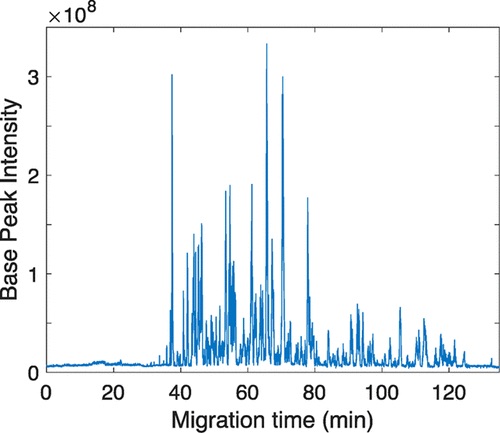
Researchers found that larger injection volumes led to broader peaks and less phosphopeptide identifications. Additionally, in this single-shot phosphoproteome analysis, researchers found 4405 phosphopeptides out of an original 220 ng enriched phosphopeptides from a mouse brain.

Data for this study is available in the ProteomeXchange with identified PXD012888.

Graphical abstract for Zhang et al. This graph shows how Base Peak Intensity compares to Migration Time (in minutes). It appears that base peak intensity is higher during the 38 minute mark, the 63 minute mark, and the 65 minute mark.

Brademan Paper on the Interactive Peptide Spectral Annotator

Brademan et al unveiled the Interactive Peptide Spectral Annotator (IPSA), in a recent issue of Molecular and Cellular Proteomics.

The IPSA is an interactive and easily-accessible web-based annotator that can be used to conceptualize and characterize peptides with mass spectra. This tool, which can visualize peptides collected from different experimental and instrumental sources, has a variety of purposes including creating figures for publication, annotating spectra for negative-mode ionization and the like.

The IPSA can be accessed through this link:
http://www.interactivepeptidespectralannotator.com

2nd Summer School a Success

The 2nd Annual North American Mass Spectrometry Summer School, which took place from July 21-24 at the Wisconsin Institute for Discovery, was a success.

The event’s goal was to encourage and stimulate a community of scientists who are interested in mass spectrometry, plants and human health. This included tutorial and research lectures, workshops and a poster viewing session. Topics ranged from data analysis, chromatography and PTMs, to data integration, intellectual property and spectral interpretation, among others.

Featured speakers included Joshua Coon from the University of Wisconsin-Madison, Ulrike Kusebauch from the Institute for Systems Biology, Beatrix Ueberheide from the New York University School of Medicine, Lingjun Li from the University of Wisconsin-Madison, Judit Villen from the University of Washington, and Evan Williams from the University of California-Berkley, among many others.

Summer School was followed by the 11th Annual MaxQuant Summer School, which took place from July 24-26 in the same location. Students were able to attend one or both events.

Next year’s summer school will take place June 15-18.

For more information, visit https://www.ncqbcs.com/summer-school-2019/