news

Viewing posts from the news category

Proteomic and Transcriptomic analyses of Toxoplasma gondii infection

Garfoot et al recently published a paper in BMC Genomics on the proteomic and transcriptiomic analyses of early and late-stage Toxoplasma gondii infection found in mice brains.

Toxoplasma gondii is a protozoan pathogen responsible for the infectious disease “toxoplasmosi,” and this pathogen is of researcher utility as it is capable of infecting a host’s brain, transitioning from fast-growing to latent morphology morphology life stages (from “tachysoite” to “bradyzoite”), and eventually creating neuronal cysts which are largely invisible to the host, as well as resilient against the host’s immune response and modern therapeutics.

Garfoot et al analyzed results from transcriptional and proteomic analyses of fast-growing (bradyzoite) fractions of the infection from mouse brains over a period of 21-150 days and, through deep sequencing of expressed transcripts found that one third of the transcripts were more enriched compared to the slow-growing tachysoites. Furthermore, researchers found that the transcript which grew the most over the course of the infection was the sporoAMA1 transcript.

As a result of this work, researchers have expanded the transcriptional profile of in vivo toxoplasmosis bradyzoites.
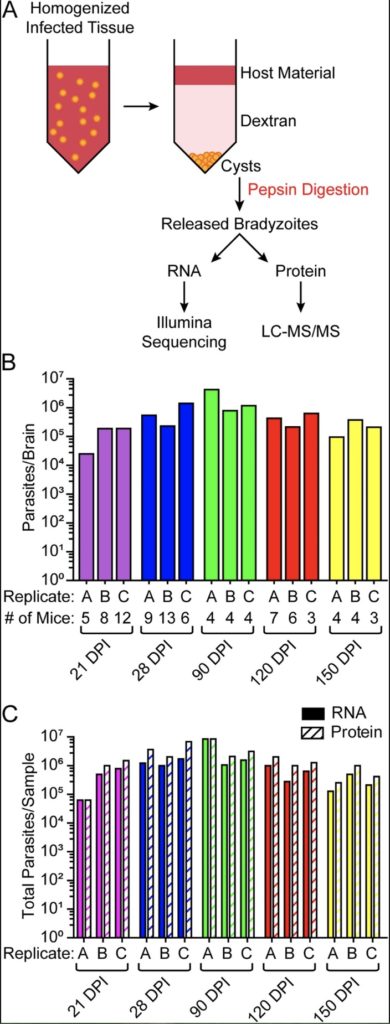
Graphical abstract for Garfoot et al's recently published a paper in BMC Genomics on the proteomic and transcriptiomic analyses of early and late-stage Toxoplasma gondii infection found in mice brains.

Software Highlight: Morpheus

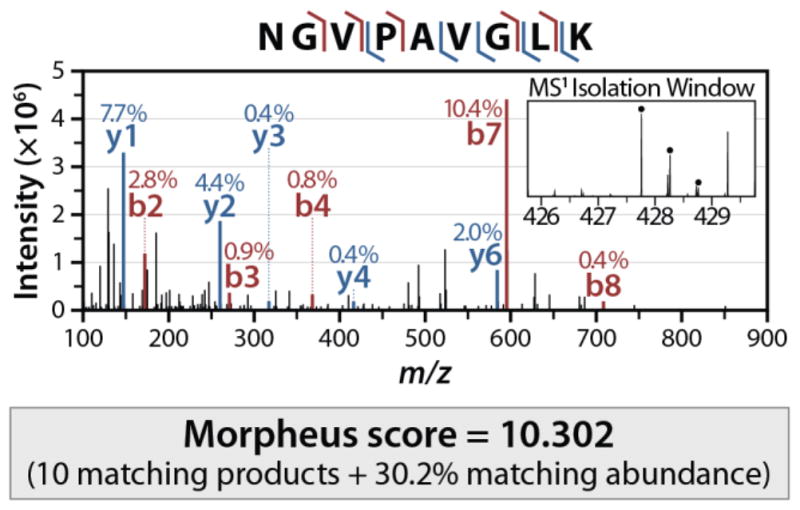
Morpheus, a custom search algorithm designed specifically for high-resolution tandem mass spectra, is one of many free softwares offered by NCQBCS.

Developed by the Coon Lab, Morpheus works specifically with high-mass accuracy data, and is superior to other similar programs, such as those originally designed for low-resolution MS/MS. For instance, compared to Mascot, Open Mass Spectrometry Search Algorithm (OMSSA) and Sequest, Morpheus can identify more spectra, peptides and proteins at a 1% false discovery rate. Morpheus is also 1.5-4.6 times faster than OMSSA.

Morpheus is free and open source under a permissive license.

The manuscript for Morpheus is available here, and the software can be downloaded here. Additionally, information on other software that the National Center for Quantitative Biology of Complex Systems offers can be found here.

Graphical abstract for the Morpheus manual, demonstrating the algorithm's matching capabilities 
Morpheus score =10.302, 10 matching products +30.2% matching abundance.

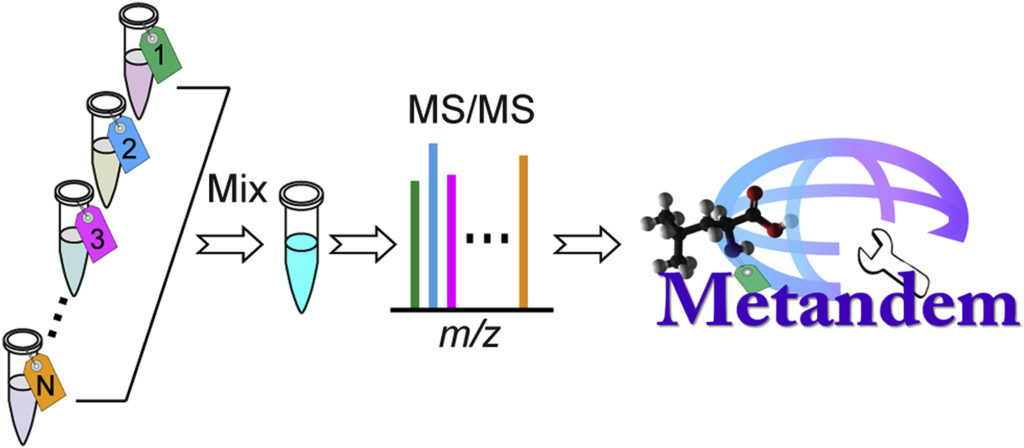
Metandem, a free and online software for MS-based isobaric labeling metabolomics

Hao et al. (2019) recently published a paper in Analytica Chimica Acta detailing the utility of Metandem, a data analysis software which is aids in isobaric labeling-based metabolomics.

While mass spectrometry-based stable isotope labeling is advantageous compared to other methods of isotope labeling due to its multiplexing and accurate quantification capabilities, its data analysis requires specifically customized bioinformatic tools. However, Metandem, a free, unique and online software, can aid in the analysis of stable isotope labeling-based metabolomics data.

Metandem has a number of different features that assist in MS-based isobaric labeling, such as integrating feature extraction, metabolite quantification and identification, batch processing of multiple data files, online parameter optimization for custom datasets, data normalization and statistical analysis.

Metatandem is available free and online at http://metandem.com/web/. 

Graphical abstract for Metandem paper published by Hao et al in Analtica Chimica Acta demonstrating the software's utility in  isobaric labeling, integrating feature extraction, and metabolite quantification.

Registration for the 3rd Annual Mass Spec Summer School Opens in January

Registration for the NCQBCS third annual North American Mass Spectrometry Summer School will open January 2, 2020.

The NAMSS summer school is an exciting opportunity for burgeoning scientists to network and learn from leading mass spectrometry experts in both plant and animal applications.

The summer school will take place in Madison, WI from June 15-18. A variety of activities, such as lectures and workshops, will be held.

Additionally, as a summer school student, you will be able to:

Present a Poster
The poster session will be held Monday afternoon (June 15th) with prizes awarded to the top entries.

Give a Flash Talk
Flash talks will be scheduled throughout the week. They are 5-minute, one-slide presentations of your work, a research question you want input on, or something else of interest you would like to ask or share with the group. Prizes awarded to the top talks.

Future Technology Discussion
The event will include a discussion titled “Future Technology Needs”, where we want to hear your ideas of what technology is missing in the current research environment that would help advance your work. This could be techniques, protocols, instrumentation capability, etc. These can be big or small ideas, realistic or just a dream.

Join World-Leading Experts for Morning Coffee and Q&A
Sign up for a morning session where you bring your questions and get help from the experts. Sessions are limited to 15 people and we request you submit a question in advance so we can come prepared for the discussion.

Tweet Your Thoughts and Ideas
Join in via twitter during the sessions.

More information on the NAMSS 2020 summer school can be found here.

Software Highlight: Compass

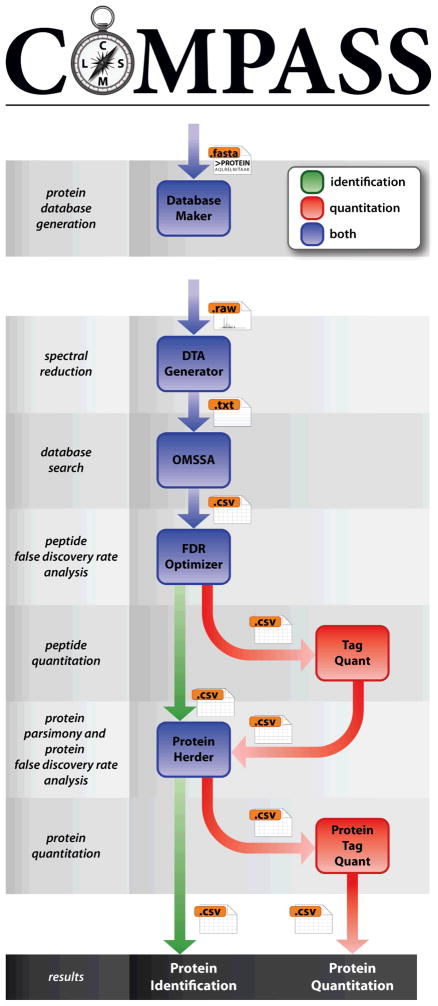
The Coon OMSSA Proteomic Analysis Software Suite, or COMPASS, is one of many custom software and web-based data tools that NCQBCS offers in an effort to extend its expertise to the broader scientific community.

Compass is a free and open-source software pipeline designed around the Open Mass Spectrometry Search Algorithm. Compass aids in high-throughput analysis of proteomics data such as FASTA database creation, peptide-spectral matching, calculation of false discovery rates, and protein grouping, as well as spectral reduction, peptide quantitation via isobaric labeling (or without), and protein parsimony.

Furthermore Compass utilizes graphical user interfaces which work well with data files in original instrument vendor format, making it easy to use.

The manuscript for Compass is available here, and the software can be downloaded here. Additionally, information on other software that the National Center for Quantitative Biology of Complex Systems offers can be found here.

Graphical abstract from the COMPASS manual, demonstrating its uses as a database maker, dta generator, fdr optimizer, and protein herder.

Selecting a Labeling Strategy for Quantitative Proteomics of Multiple Samples

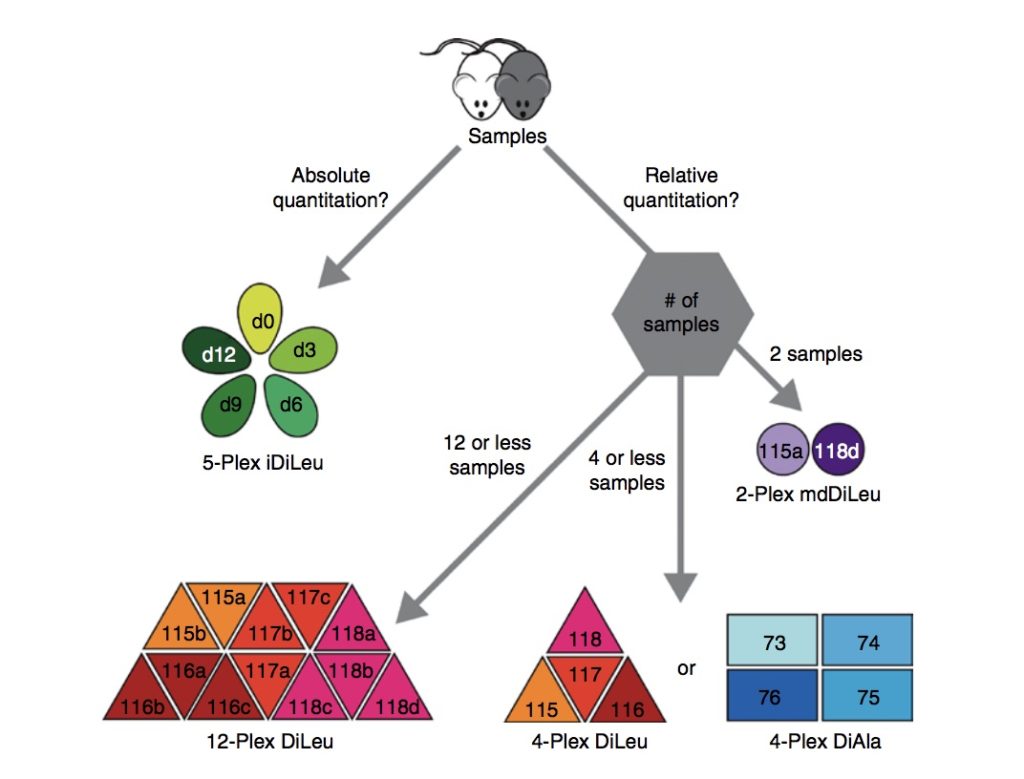
Buchberger AR et al (2019) recently published a chapter reviewing various labelling strategies for quantitative proteomic analysis in Mass Spectrometry-Based Chemical Proteomics.

Specifically, the chapter reviews strategies such as label-free quantitation, metabolic labeling, and chemical stable isotope labeling, and also discusses which labeling approach is best for various types of proteomic analyses. The chapter also provides an explanation on how to use N,N‐dimethyl alanine (DiAla) and N,N‐ dimethyl valine (DiVal) isobaric labeling strategies for quantitative analyses in ways which are economic and effective.

The chapter states that quantitative proteomics is crucial for biomarker discovery in studying and understanding various diseases and biological research, as proteins are crucial in all biological processes. Because biomarker studies can be time-consuming, heavily reliant on instruments and vary depending on the strategy used, selecting the appropriate labeling strategy is important in quantitative analysis.

A graphical abstract from Buchberger et al (2019) which depicts labeling strategy options for a type of sample. The sample in the picture is a mouse, the labeling strategies include 5-plex iDiLeu, 12-Plex DiLeu, 4-Plex DiLeu, 2-Plex mDiLeu, and 4-Plex DiAla.

NCQBCS Offers Broad Range of Training Programs for all Levels of Learners

A key goal of the National Center for Quantitative Biology of Complex Systems is to extend its expertise to the broader scientific community. Therefore, NCQBCS offers hands-on-training programs ranging from basic basic proteomic methodology to advanced technological techniques.

NCQBCS, which works to develop next-generation protein measurement technologies for biomedical application, has programs available for a wide range of students. This means that there are introductory training programs available for those interested in learning the basics of mass spectrometry, as well as programs geared for experts on specific technologies.

NCQBCS divides its training topics into four broad categories: Sample Preparation, Instrumentation, Data Analysis, and Protein Quantification. Trainees can build their own syllabus of workshops from a variety of categories and experience levels.

Comprehensively, we offer programs in:
Sample Preparation: Peptide Fractionation, Protein Digestion, Protein extraction.
Mass Spectrometry: MS Methods, Instrument Troubleshooting, Nano-chromatography.
Data Analysis: Data Visualization, Data Interpretation, Data Searching.
Protein Quantification: Label-free, Metabolic labeling, Isobaric chemical labeling.

More information on our training programs are located here, and one can sign up for training here.

Additionally, one can also receive coaching at the 3rd Annual North American Mass Spectrometry Summer School, which will take place June 15-18, 2020. This event, which will be hosted by international experts on Mass Spectrometry, will feature workshops, lectures and networking, among other activities.

One may find more information, as well as sign up for summer school, here.